In the ever-changing world of technology, it can be challenging to keep up with the latest AdTech and MarTech developments. Enter: AdThink, a collaborative event with the Winmo, Redbooks (recently acquired by Winmo), and the Ad Club of New York highlighting up-and-coming technologies that you need to know about.
Earlier this month, AdThink’s August event featured three exciting technology companies, Arkadium, BoardActive, and StatSocial. To share the wealth, we’ve dropped in some highlights from each presentation, as well as more details about each product.
Take a closer look at the AdTech featured below!
AdTech Made To Enhance Content: Meet InHabit by Arkadium
Arkadium provides interactive website content, including data visualizations, games, quizzes, and polls, to digital publishers like Sports Illustrated, USA Today, Washington Post, and the Los Angeles Times. Launched in 2001, the company has a hand in content and game development across a variety of channels, providing everything from Microsoft software’s Solitaire game to data visualizations on Sports Illustrated’s website.
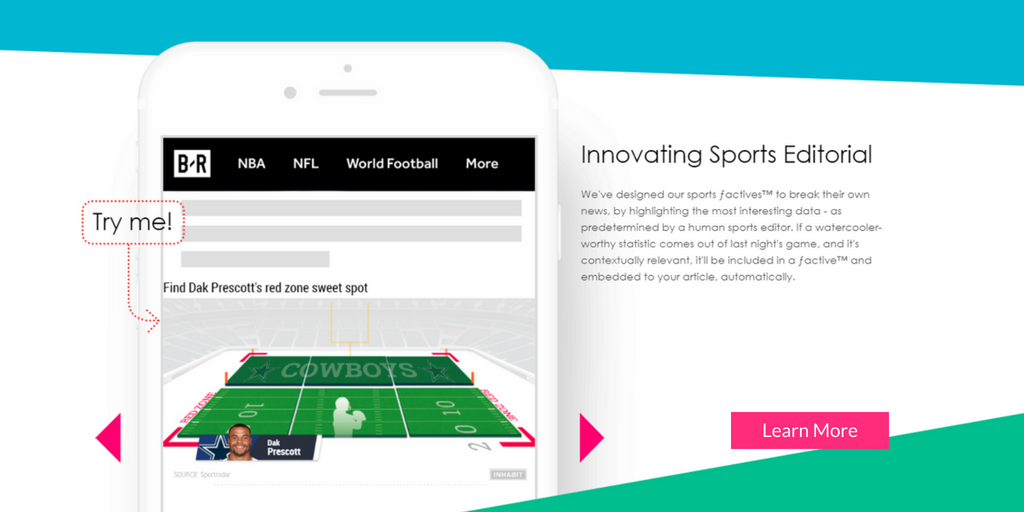 Arkadium’s newest product, InHabit, takes the company’s mission of providing engaging content to the next level by utilizing artificial intelligence to populate ƒactives™, defined by the company as, “Arkadium’s interactive data visualization that amplifies human editorial with artificial intelligence, boosting user interaction and session duration.” The company’s code is placed on a page, where it automatically reads the content and processes the main idea of the article. Using that AI, a “ƒactive” about the main idea is places on the page with relevant data. For a better understanding of the product, check out Arkadium VP of Product Robert Caliolo’s fantastic Tom Brady example in the video above.
According to InHabit’s mission, the company has designed “sports ƒactives™” to break their own news by highlighting the most salient data, as predetermined by a human sports editor. “If a watercooler-worthy statistic comes out of last night’s game, and it’s contextually relevant, it’ll be included in a ƒactive™ and embedded in an article automatically,” says the company.
Best of all, these graphics demonstrably increase user retention (by 37%), engagement (by 39%), and session duration (by 100%). While InHabit is only rolled out to sports editorial platforms right now, the company sees potential across subjects. In his AdThink Q&A session, Caliolo said, “We think InHabit is much larger than sports. We think it’s relevant for any data-heavy industry. Finance, real estate, weather, politics, entertainment — we think all of these are really interesting.”
Learn more about InHabit and Arkadium, and check out the video above to learn more about the product and parent company.
When AdTech Gets Personal: Meet BoardActive
Meet BoardActive, a visual signage software that connects advertisers to consumers via their mobile devices. The company’s software, iAdvertising, places targeted ads and special offers on consumers’ smartphones when they drive, walk, or ride past any “BoardActivated” media — like a billboard, bus advertisement, etc. BoardActive aims to create synergy across platforms when consumers encounter advertising; whether or not a consumer is aware, the company is, in essence, engineering messaging serendipity.
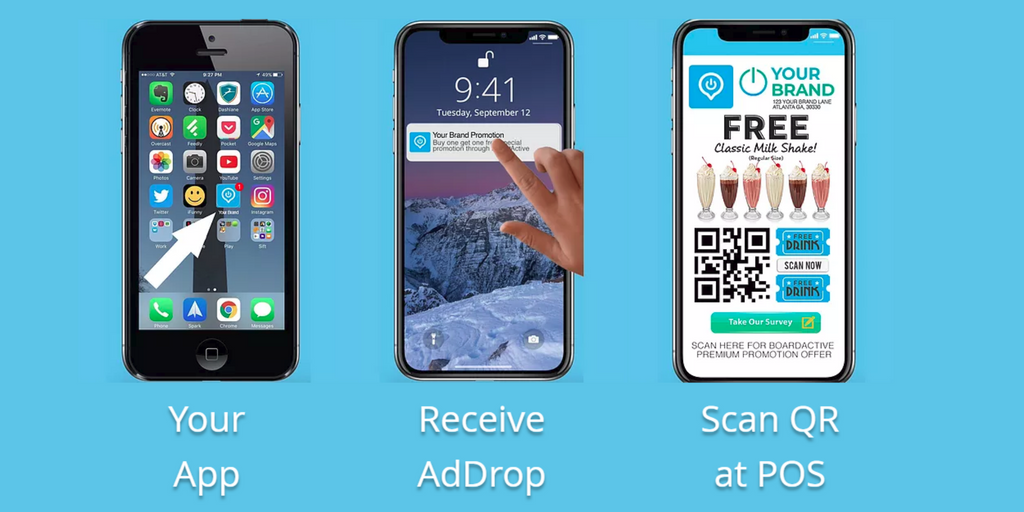 The mechanism with which BoardActive is able to push these offers to geotargeted consumers is called AdDrop™. When consumers enter a geofenced area around an advertiser’s message, consumers are pushed an AdDrop message with offers to their mobile device. These messages and offers are completely customizable for each advertiser, including dates and times of messages, offers and promotions, information, immersive media, and more. While a consumer might not actively engage with your initial ad, AdDrop messaging can’t be avoided — meaning more reach, and more influence over buying behavior.
A boon for advertisers: these push notifications pop up regardless of whether or not a consumer is using your app currently, and push to the home screen, even when a phone is locked. Should a consumer miss the notification, a badge will appear on the advertiser’s app.
Unique to BoardActive’s value statement is its ease for advertisers on the platform. Once the iAdvertising STK is embedded onto an advertiser’s site, the company can immediately begin pushing AdDrops to users — no additional software of functionality required.
Learn more about BoardActive’s unique offering from CMO Jeff Gropper in the video above, and check out their website for more on the platform’s technology, tracking, and results.
AdTech X Audience: Meet StatSocial
StatSocial breaks down social following into granular, actionable insights. Want to know about the @Nordstrom following’s buying behavior? StatSocial can help you out. Interested in learning about the people mentioning @HBO in social posts? StatSocial is your tool. The use cases go on, and on, and on.
 But that’s not all! StatSocial can also help target a particular segment across social channels. An example: If you want to target 25 to 34-year-old males who make over $50,000 a year, live in NYC, and watch Game of Thrones, StatSocial can find and target those individuals on social. The platform can also give you detailed data and insights about this group, like what other shows they watch, who they follow on social, their favorite brands and celebrities, and more.
Perhaps the most impressive aspect of the StatSocial platform is its ability to go deep — real deep. According to the company, the platform’s “multi-layer taxonomy indexes 370 interests, 1,100 tv shows, 8,200 consumer brands and 22,000 celebrities” to find exactly what you’re looking for in an audience profile across 40,000 distinct segments. And with data from 60+ social and blogging platforms scanned, StatSocial take “thorough” to the next level.
StatSocial Matt Hussey broke down a recent use case for our AdThink and really highlighted how the platform helps brands and advertisers learn about followings, both of owned channels and those of competitors. Check out the video above, and learn more about StatSocial on their website.
P.S. Feeling compelled by the StatSocial product? Request a Winmo trial and get familiar with our StatSocial integration.

TV Ad Buy and Airing Intel Now in Winmo
in Ad Sales, Breaking News, Marketing Techby Marilyn Mead BrutocoWinmo has teamed up with real-time TV ad measurement leader iSpot.tv to give users of its sales intelligence platform a valuable tool for winning ad revenue. The new integration, available to customers of Winmo’s top-tier subscription plans, brings a selection of TV ad metrics from iSpot.tv into the Winmo platform, breaking down broadcast media budgets alongside the decision-makers who spend them. Likewise, Winmo integrated its sales intelligence into the dashboard of iSpot.tv, allowing iSpot customers to get contact information when utilizing its advertising analytics platform.
The Technology
iSpot.tv’s proprietary TV ad measurement technologies provide disruptive brands and TV networks with a comprehensive view of advertising activity across linear, time shifted, OTT and on-demand TV environments. The company measures impressions, attention to creatives and connects ad exposures to business outcomes. While the company is largely known as the leading measurement platform for brands and networks, the Winmo integration builds on the data’s inherent value to sellers as well.
“Our goal is to provide publishers, networks and agencies breakthrough transparency into TV ad intelligence as a part of a complete picture of an advertiser,” said Dave Currie, CEO of Winmo’s parent company, List Partners LLC. “This brings key ad metrics from iSpot.tv into Winmo’s advertiser profiles, as well as enhanced lead-targeting that empowers our customers to win and retain more ad business.”
The Integration
Initially present on over 1,600 advertiser profiles in Winmo, the iSpot.tv ad metrics integration allows users to jump directly from a brand’s contacts and agency relationships to its TV creative, airings, top networks and top TV shows, offering a 360-degree view of how budgets are being spent.
Enhanced Search: Media by Network Filter
In addition to viewing the TV ad metrics directly on advertiser profiles, Winmo is beta testing search functionality that narrows down advertisers by network, based on a window of airing data from iSpot.tv.
Users can leverage the new Media by Network search filter to hone in on brands whose ads have appeared on specific media properties, making the integration a valuable tool for identifying targets spending with competing networks.
The result is a seamless experience where ad sellers can find leads, qualify opportunities, and then, using the proprietary business intelligence Winmo is known for, identify the exact brand and agency buyers making purchase decisions to close more deals.
About Winmo
Winmo’s advertiser and agency database tracks decision-makers who control $100 billion in marketing spend each year, allowing sellers to build lists, open doors, and close deals faster than ever before. In addition to up-to-date contact details, Winmo’s award-winning sales intelligence platform boasts trigger-based opportunity alerts, integrated ad spend and buying behavior – all designed to help sellers reach the right contacts on the right accounts at the right time. For more information or to request a free trial, visit winmo.com.
About iSpot.tv
iSpot is a TV advertising measurement company that brings transparency, digital-like precision, and control to disruptive brands. The real-time platform empowers marketers with a complete view of advertising impressions, engagement, attention conversion across all forms of TV, and connects those analytics to business outcomes. To learn more, visit www.ispot.tv.
Sponsorship Expert: How to Close Your Sponsorship Deal With Data
in Business Development, Sponsorshipby Larry WeilNot all data is created, says Winmo partner and sponsorship expert Larry Weil. Instead, he’s sharing how to close a sponsorship deal with data points that are actually meaningful to prospects, and what insights to leave OUT of your pitch deck.
You have done your homework and have used insights to identify a prospect that is likely to value your property. You have figured out your value proposition. You have captured their interest and got the call or the meeting. You have invested hours in creating an appealing presentation. You have told your story, captured their imagination. You can feel it, they are interested. It wasn’t easy to get here, but you are now way down the sales funnel.
The next step is the going to be analytics. Your prospect will ask for the data to measure the potential performance of your proposal. You send them your web, social, demographics and attendance. A few days go by. Things start to slow down. Calls aren’t getting returned. Everything grinds to a halt. What went wrong?
Big brands are sophisticated about data. They have likely invested millions and millions of dollars in collecting, analyzing and reporting the information they need to make decisions. If you want them to take your sponsorship proposal seriously, you must be able to speak the language of data and provide them with insights that validate choosing your property for partnership.
If you are a Winmo user as I am, you are already used the platform to identify the prospect, understand how they spend their marketing dollars, identify triggers, budgets, even how to appeal to individual decision makers.
Why do you do this? Because it helps you make much better decisions about who is a good prospect and who is not. But are you giving your prospect a similar quality of data that allows them to make the right decisions about working with you? My experience is that in many cases the answer is no.
So how do we fix that? Let’s start by identifying what kind of data is and is not going to help you close deals.
The Sponsorship Data That Doesn’t Matter
When I am onboarding clients one of the first things we ask about is what kind of data they have. Usually, they respond with:
I try to help my clients understand that these measurements mostly don’t get to the root of what is most valuable to brands. It won’t present your property as having more than a rudimentary level of data. I’m not suggesting you throw these insights aways; I’m suggesting that it won’t close any deals. Here is why:
Close Your Sponsorship Deal With Data That Matters
To get to the information that will get the deal closed, try thinking about this the way to prospect would. They need some data that proves what you say and makes your property a match and worth the investment. Here some key data points that will help close the deal:
If you can use data to show that your attendees or audience is the one the prospect values, that they are engaged in a meaningful way, that you have a large number and that you can provide them at a competitive cost. You will close the deal.
Why Referrals Are a Bad Business Development Strategy
in Business Developmentby Betsy HicksOut of curiosity, what’s your agency’s business development strategy? If you said, “I don’t know,” “We don’t have one,” or “Referrals,” then this blog is for you.
We hear it all the time: “Our agency doesn’t need to prospect for new business, because we’re already swamped with Super Big and Lucrative Client.” But ask yourself, what happens if Super Lucrative Client takes their business elsewhere? What was once a rosy picture turns bleak, and fast.
Should worse come to worse and you do lose an important client, it’s vital that your agency has a strategy underway to find and finesse new relationships. Moreover, we at Winmo firmly believe that the natural influx of working relationships shouldn’t dictate the rise and fall of your small agency empire. To help you consider your agency’s business development strategy, we’re sharing some vital contextual info about agency business development and detailing why referrals are no longer a viable business strategy. Plus, we’ve got some top tips on how to jumpstart your agency’s business development quickly and effectively.
Reality Check: The State of Agency Business Development
We’re not really ones for fear-mongering, but we believe that it’s fair to say that changes in the agency and media landscape are some cause for concern in terms of business development. Here’s what’s up:
The agency as an institution isn’t going anywhere; the incredible work produced by agencies of all sizes represents far too much value to disappear overnight. But the landscape is changing! It’s important that your agency move, and more importantly grow, with it.
What NOT To Do: Why You Shouldn’t Rely on Referrals Alone
So, full disclosure: we’re a sales intelligence company, so we have a stake in the idea that referrals are a bad growth strategy.
But, actually, referrals ARE a bad growth strategy!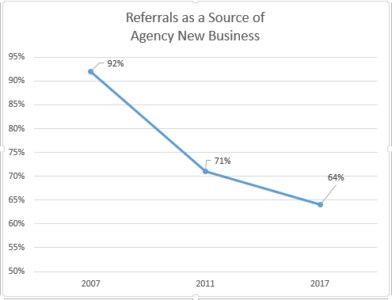
In 2007, 94% of agencies chose “referrals” as one of their three primary sources of new business for the firm. In 2011, that number dipped to 71%. This year’s RWS/US report revealed that referrals are at an all-time low, with only 64% reporting the channel as a top-three source of business.
We all know that the Don-Draper-drinking-at-the-office days of the agency world are out of date. Just as antiquated, though, is the idea that business should come to you. The fact is, proactivity is rewarded, and projects or accounts are earned. “Grow” is an active verb, not a passive noun.
Really, it’s simple math: the more chances you have to win business, the more likely you are to win business. Referrals are great (when they happen), and we’re not suggesting that you abandon the networking ship altogether. Instead, we’re arguing for the maximalist strategy; increase your development channels, actively prospect potential clients, and create a robust business pipeline to see your agency flourish.
The Solution: 4 Business Development Tips
If you’re looking to expand your business development capacities and aren’t sure where to start, consider these four tips:
Ready to jumpstart your business development strategy today? Request a Winmo trial and flood your pipeline with valuable prospects.
Sales Email Templates: 7 Emails Worth Sending
in Business Developmentby Jennifer GroeseSales email templates: the ultimate hack.
Salespeople know that email is vital to an effective prospecting strategy. If you feel like it’s time to change up your email outreach — whether that’s because it’s no longer delivering the returns you’ve come to expect, or because you were never really certain where to start in the first place — you’ve come to the right place. As a sales organization ourselves, we at Winmo have access to some of the most tried-and-true sales emails. We assembled a crack team of salespeople and asked our team: what works for you?
Below, you’ll find seven emails (plus subject lines!) that our team relies upon when reaching out to prospects. Stripped of the Winmo-specific language, these mad-libs-style templates are ready-made for your sales success. Download the templates and get to emailing!
P.S. Find a template the really works for you? Let us know in the comments below!
AdTech You Need to Know About: AdThink 2018
in Marketing Techby Betsy HicksIn the ever-changing world of technology, it can be challenging to keep up with the latest AdTech and MarTech developments. Enter: AdThink, a collaborative event with the Winmo, Redbooks (recently acquired by Winmo), and the Ad Club of New York highlighting up-and-coming technologies that you need to know about.
Earlier this month, AdThink’s August event featured three exciting technology companies, Arkadium, BoardActive, and StatSocial. To share the wealth, we’ve dropped in some highlights from each presentation, as well as more details about each product.
Take a closer look at the AdTech featured below!
AdTech Made To Enhance Content: Meet InHabit by Arkadium
Arkadium provides interactive website content, including data visualizations, games, quizzes, and polls, to digital publishers like Sports Illustrated, USA Today, Washington Post, and the Los Angeles Times. Launched in 2001, the company has a hand in content and game development across a variety of channels, providing everything from Microsoft software’s Solitaire game to data visualizations on Sports Illustrated’s website.
According to InHabit’s mission, the company has designed “sports ƒactives™” to break their own news by highlighting the most salient data, as predetermined by a human sports editor. “If a watercooler-worthy statistic comes out of last night’s game, and it’s contextually relevant, it’ll be included in a ƒactive™ and embedded in an article automatically,” says the company.
Best of all, these graphics demonstrably increase user retention (by 37%), engagement (by 39%), and session duration (by 100%). While InHabit is only rolled out to sports editorial platforms right now, the company sees potential across subjects. In his AdThink Q&A session, Caliolo said, “We think InHabit is much larger than sports. We think it’s relevant for any data-heavy industry. Finance, real estate, weather, politics, entertainment — we think all of these are really interesting.”
Learn more about InHabit and Arkadium, and check out the video above to learn more about the product and parent company.
When AdTech Gets Personal: Meet BoardActive
Meet BoardActive, a visual signage software that connects advertisers to consumers via their mobile devices. The company’s software, iAdvertising, places targeted ads and special offers on consumers’ smartphones when they drive, walk, or ride past any “BoardActivated” media — like a billboard, bus advertisement, etc. BoardActive aims to create synergy across platforms when consumers encounter advertising; whether or not a consumer is aware, the company is, in essence, engineering messaging serendipity.
A boon for advertisers: these push notifications pop up regardless of whether or not a consumer is using your app currently, and push to the home screen, even when a phone is locked. Should a consumer miss the notification, a badge will appear on the advertiser’s app.
Unique to BoardActive’s value statement is its ease for advertisers on the platform. Once the iAdvertising STK is embedded onto an advertiser’s site, the company can immediately begin pushing AdDrops to users — no additional software of functionality required.
Learn more about BoardActive’s unique offering from CMO Jeff Gropper in the video above, and check out their website for more on the platform’s technology, tracking, and results.
AdTech X Audience: Meet StatSocial
StatSocial breaks down social following into granular, actionable insights. Want to know about the @Nordstrom following’s buying behavior? StatSocial can help you out. Interested in learning about the people mentioning @HBO in social posts? StatSocial is your tool. The use cases go on, and on, and on.
Perhaps the most impressive aspect of the StatSocial platform is its ability to go deep — real deep. According to the company, the platform’s “multi-layer taxonomy indexes 370 interests, 1,100 tv shows, 8,200 consumer brands and 22,000 celebrities” to find exactly what you’re looking for in an audience profile across 40,000 distinct segments. And with data from 60+ social and blogging platforms scanned, StatSocial take “thorough” to the next level.
StatSocial Matt Hussey broke down a recent use case for our AdThink and really highlighted how the platform helps brands and advertisers learn about followings, both of owned channels and those of competitors. Check out the video above, and learn more about StatSocial on their website.
P.S. Feeling compelled by the StatSocial product? Request a Winmo trial and get familiar with our StatSocial integration.
Why Prospecting Is Important: Eight Tips For Reaching the Decision Maker
in Business Development, Salesby Betsy HicksUpdated: June 6, 2019
You might be thinking, “Why is prospecting important for sales?” First, it’s important to answer the question: what is prospecting? Prospecting, the first step in the sales cycle, is the process of identifying and connecting with potential customers. The goal of prospecting is to build a sales pipeline, wherein a salesperson consistently connects with a potential customer to develop a rapport with the intention of eventually, closing a sale.
You may be thinking, is prospecting really essential to your company and team success? Maybe you’ve got your eyes set on a few big-name partners to buy a majority of your available inventory and don’t think that traditional prospecting is really applicable for your business. Perhaps you don’t know or care why prospecting is important, because you’ve got a lot going on. Lean teams and big expectations are a dime-a-dozen in the sponsorship world, and we’re willing to bet that you’re pretty busy.
Prospecting isn’t optional if you want to be successful in the sales world.
Why prospecting is important
Unfortunately, sales are rarely easy to close; similarly, identifying potential customers and connecting in a meaningful and NOT-predatorily sales-y way is actually really challenging! Luckily, we at Winmo are here to provide some insights and tips to ease the prospecting pain and help you reach all of your wildest sponsorship sales goals and beyond.
Prospecting is important because it creates more opportunity. Think of this way: it takes time to convert a prospect to a sale and can be particularly tricky in a sponsorship context. To maximize your assets and sell to your goal (and beyond), you need to start building a sales pipeline for potential partners early and build upon it often.
Still skeptical as to how and why prospecting is important? Because ball don’t lie (and data doesn’t, either):
Now that we’ve covered the prospecting basics, let’s dive into eight tips for sales prospecting.
Eight tips for reaching decision makers
1) Define your audience.
The process of prospecting can be overwhelming — Winmo has over 32,000 brand contacts! By defining the characteristics of your ideal partners, you can utilize search functionality to build a list that suits your needs, and narrow the field to something more manageable. Not using Winmo? The same advice applies. (Though we also recommend requesting your free trial to get a feel for what you’re missing.)
2) Tailor your email subject line to your prospect.
If we’ve said it once, we’ve said it 21 ways. You won’t get anywhere with an email that decision makers don’t care to open. Optimize, personalize, and reach out with confidence.
3) Strike while the iron is heating up.
Not when the iron is already hot. The timelines people in like aren’t just punctual, they’re early. Rip a page out of that book, and consider, “If you’re on time, you’re late,” your new sales mantra, because, in this business, timing is everything. Rather than waiting for agency reviews to be announced or RFPs to be sent out, target clients who are preparing to dump current partners with WinmoEdge’s predictive sales intelligence. With a 74% accuracy rate, WinmoEdge will help you prospect clients that are in the search mindset.
4) Make prospecting a habit.
Prospecting is like exercise: the more you do it, the easier it gets. Getting in touch with a prospect is like winning the lottery, so it’s vital that you up your chances by reaching out regularly. We recommend blocking out a couple hours each day to update lists, craft emails, and follow up with potential prospects. You read that right: every day.
5) Find a commonality.
In sponsorship sales, there’s a unique opportunity to personalize your pitch to your non-profit, event, etc. Use that personalization to your advantage by finding a commonality with your prospects. It’s a known fact that people are hardwired to like people who seem similar, so use this to your advantage; we recommend using social media, LinkedIn, and professional bios to get a sense of who you’re emailing. Or, if you’re a Winmo member, use the custom Crystal Knows information to personalize your outreach efforts.
6) Track your rejections.
While we don’t generally recommend focusing on the negative, in prospecting, we recommend keeping track of the contacts that say no, and their reasons for doing so. This process will help you refine your pitch to common concerns, and will ultimately get you that much closer to your “yes.”
7) Utilize Influencers.
One of the biggest mistakes salespeople make is only reaching out to top-level executives. While Vice President and C-Suite executives typically have the final say, they are also the ones whose inboxes are most inundated. The influencer is an important person to impress because they are the ones who would greatly benefit from finding the right tool or service to take their work to the next level. After capturing the influencer’s attention, they can then create a proposal for their boss and the ultimate decision-maker.
8) Understand company size.
Depending how large or small a company is, different titles may have different responsibilities. For example, a smaller business has fewer gatekeepers, meaning you will want to approach the CEO or a member of the C-Suite. For larger businesses, the best contact may be slightly lower on the totem pole. Ultimately, the size of the company determines the types of titles to approach, and also suggests certain challenges the company may be able to overcome through using your product.
What are the benefits of prospecting?
If you liked this blog post, check out:
List Partners Named to the Inc. 5000 List for the Sixth Year
in Breaking Newsby Betsy HicksWhen something good happens once, you might think it’s a fluke. When it happens twice, it might be a coincidence.
But six times? That’s a pattern of continued success.
Typically, we like to use our blog to highlight our client successes and strategies. But today, we’re thrilled to share a little success of our own! List Partners (Winmo’s parent company) has been named No. 3,525 on the 2018 Inc. 5000 list of fastest growing privately-held companies in the U.S.
As we mentioned, this isn’t our first rodeo. Last year, our fifth list appearance, we ranked No. 3,149. We also made the cut in 2016, 2011, 2010, and 2009. Over the years, the Inc. 5000 list has included companies such as Microsoft, Timberland, Vizio, Intuit, Chobani, Oracle, and Zappos.com — talk about good company!
For the uninitiated, the Inc. 5000 is an annual list of the fastest growing private companies. Presented by Inc. Magazine, the list tracks companies based on the previous three years of revenue growth. To qualify for the list, companies must be U.S.-based, privately held, and independent, not subsidiaries or divisions of other companies. Revenue in the first year of tracking must have been at least $100,000, while revenue in the most recent year of tracking must be at least $2 million.
For some perspective, consider this: in 2016 (the most recent data available), the U.S. had 7,757,807 employers (privately-held companies that actually employ people), and 27,626,360 firms (total privately-held companies, including incorporated entities that don’t actually employ people, but likely serve as an investment vehicle). That’s a lot of corporate jargon, but when you break it down with a little simple division, it means that List Partners is in the top 0.045% of the fastest-growing businesses in the U.S.
We’re proud of this accomplishment, but we’re also acutely aware of how we’d be nothing without you, our valued clients. We’ve had a HUGE 2018 thus far (hello, Redbooks, Access Confidential, and AAR Partners acquisitions, new integrations with Crystal Knows, Hookit, and more!), but we’re not looking to slow down anytime soon.
Next up: more incredible integrations, more award-winning sales intelligence, and more incredible client service. Basically, more good stuff!
Best Subject Lines For Sales That You Need to Start Using Today
in Business Developmentby Betsy HicksThe best subject lines for sales: a David Blaine illusion, or real, actionable copy?
More and more, the standard sales email subject lines read as derivative, ineffectual, or overtly salesy, while more nuanced, gentle call-outs go unnoticed, unclicked, or outright ignored. We hear you! To help kick your sales email strategy into high gear, we’ve aggregated 21 of the best subject lines for sales that you need to start using today. Like, right now.
But Does The Email Subject Line Matter?
Yes. Plain and simple, email subject lines are incredibly important. According to Convince & Convert, 35% of email recipients open messages based on the subject alone, meaning that a compelling subject can be the difference maker for new contacts and prospects when sending emails!
Another important stat to keep in mind: 21% of email recipients will report email as Spam, even if he/she knows the email isn’t. If your email reads as impersonal, formulaic, or inaccurate from the jump, you have a much greater chance of going straight to Spam in the future, so be mindful!
Four Principles of the Best Subject Lines for Sales
We’ve dropped 21 killer examples of the best subject lines for sales below, but it’s important to understand the elements of an actionable, impactful email subject line for future reference!
If you’re anything like us, you’re probably cranking out emails all day, every day. These are four of the most important tips to keep in mind when drafting the best subject lines for sales emails:
Pro Tip: Ensure your personalization is tailored to a prospect by using Winmo’s Crystal Knows integration. With accurate insights into contact’s personality, communication style, and even emoji recommendations, Crystal Knows will arm you with the valuable information you need to create killer subject lines and email content for every prospect.
21 of the Best Subject Lines for Sales to Start Using Today
B2B Leads to Watch in H2: Who to Target in 2018
in Agency New Businessby Betsy HicksSo you’re looking for B2B leads to target in H2.
Good news — you’ve come to the right place! As we dive into the second half of 2018 (how did we get here already?!), it’s crucial to make savvy decisions in which CMOs and brands to target. Luckily, we at Winmo have done the lead generation legwork and can report that there are some big names likely up for agency review soon!
In our new eBook, CMOs to Watch: H2, we’ve identified six CMOs appointed in H1 that have yet to launch agency and media relationship reviews. These decision makers are poised to evaluate strategy and shake things up, so be sure to download the eBook and get on the horn before these exciting pieces of new business are scooped up.
Some eBook highlights:
Methodology: How Have We Identified These B2B Leads?
We know what you’re thinking: leads are great, but only if they’re based on genuine interest and need. We agree! That’s why we’ve used our tried-and-true methodology to identify the most significant potential contacts and clients for our loyal Winmo following.
If you’re in this business, you likely already know that a newly appointed CMO is a strong predictor of agency reviews. But maybe you’re also wondering, how have you narrowed the pool down to six CMOs? Fair question! When deciding who to highlight in our CMO eBook, we considered a variety of factors, including:
CMO spotting isn’t a perfect science, but as you can see, we put some rigor behind our suggestions. Plus, this isn’t our first rodeo! Back in January, we put together a similar eBook highlighting H1 opportunities, in February, we shared this list of brands to woo, and the list goes on — not to mention our 78% success rate when predicting agency change.
B2B Leads You Can Use: Your Next Steps
Information in hand, it’s time to make some moves. But first, motivation! To go along with our six CMOs, we’re sharing six prospecting tips to kickstart your sales process.
Now that we’ve covered absolutely everything, go get ‘em! Download the eBook, get in the platform and flesh out that background detail, and walk confidently into H2.
Build a Better Business With Employee Engagement
in Breaking Newsby Betsy HicksEver watch a TEDx Talk and think, “Wow. I have to talk to that person, STAT?”
Us, too. In fact, Don Rheem’s How can work save our relationships talk stuck with Winmo leadership so much, CEO Dave Currie brought Don, a former science advisor to Congress and White House correspondent, and his team at E3 Solutions to our hometown of Atlanta, GA. In his words, Dave invited Don to speak to the group because, “at List Partners, we have a high-performance culture that enables our team and our customers to thrive. We continually invest in the best and brightest and have been honored to have Don join us this week to help us set new performance benchmarks and provide our tribe with a detailed platform for ongoing improvement.” On Monday, we did just that! Don walked our team through a day-long workshop on workplace engagement and management best practices, and to drill down into E3’s analysis of Winmo & Co.’s employee engagement survey results.
Take it from us: It. Was. Fascinating.
And on Monday, we did just that! Don walked our team through a day-long workshop on workplace engagement and management best practices, and to drill down into E3’s analysis of Winmo & Co.’s employee engagement survey results.
Take it from us: It. Was. Fascinating.
So much so, that we wanted to share five takeaways from the day:
As a company, we take our culture very seriously; it matters that our employees are enthusiastic, fulfilled, and engaged with their work because we know that these factors result in happier, more content people, in and outside of the workplace. Don’s engagement survey results, in concert with things like being named one of Atlanta’s Best & Brightest Places to Work, help us gauge how well we’re building and maintaining the culture we want. So far, so good!
If you haven’t had a chance to watch Don’s TEDx Talk, do! You can also check out more on the neuroscience behind employee engagement in his new book, Thrive By Design, or by following him on social media.