Step aside Cupid! There’s a flurry of CMOs breaking up with brands and we’re here to make it right.
Like any other national holiday centered around love and chocolate-covered deliciousness, no one should be left out in the cold- including big brands. So, we’ve decided to play matchmaker and help mend the broken hearts of five brands that recently went through CMO breakups.
Keep in mind, with any CMO breakup, this typically signals that major agency roster changes are likely to occur in the next 6-18 months. That means that now is the time to start wooing these brands if you want to catch their eye or land some potential new business. They could be your perfect match!

Just a few weeks after Mark Zuckerberg announced that Facebook would limiting the ads on the platform to focus more on family and friends, CMO Gary Briggs decided it was time to see other people. Briggs announced that he would be stepping down from his position, but won’t be leaving until the new CMO comes in and gets situated, however long that may take.
Either way, Briggs will be leaving and a new CMO will be coming in, so changes are coming. That also means advertising, media and other work could be up for grabs, especially given Facebook’s issues since 2016. Start contacting lower level marketing positions (director and VPs), who can help refer you to the new CMO once he/she starts. Your competition for work will include WPP’s Mindshare, which has handled media since 2016. Creative is handled in-house.
Sellers – Facebook attracts a wide range of users to appeal to as many advertisers as possible. Thus, they run traditional and digital ads all year on a variety of platforms. ISpot reports a 2017 national TV spend of $12.1 million. 2016’s spend was $36.6 million.
Request a trial to access the decision maker info for Facebook here

Becky Gebhardt, Lands’ End‘s CMO and chief creative officer decided things weren’t working and left the struggling retailer at the end of 2017. She departed just as Gill Hong and Sarah Rasmusen joined as chief merchandising officer and e-commerce SVP, respectively.
Currently, LE is on a mission to shift spend into “more effective channels,” so look for more direct marketing, in addition to continued digital and print media. Note that LE is planning on opening standalone stores in fiscal 2018 and announced a new partnership with The Weather Channel last November.
Per Pathmatics, LE spent $262,000 on digital display ads in 2017. This is down from the $761,000 spent during 2016. Sellers, while 2016’s spend was targeted to fashion and female-focused sites, 2017 spend shifted into coupon and deal sites. LE does not currently spend on national TV ads, according to iSpot.
Agency and maretch readers – Lands’ End handles traditional marketing in-house, while Dentsu Aegis’s 360i, Atlanta is responsible for digital media buying and planning, search and mobile, according to Winmo. Be sure you are getting pitches together and engaging the team now.
LE has struggled to reach new and existing customers and could be looking for new partners and ideas to reach its target audience through refreshed initiatives.
Request a trial to access the decision maker info for Lands’ End here

Struggling Mattress Firm should be on your prospecting radar after Sicily Dickenson, CMO for only about a year, resigned (I think it went something like “It’s not you, it’s me”). The mattress retailer appears to be bouncing back quickly, already looking for her replacement while marketing VP Christy Sherrick runs the show. Also, six-year CEO Ken Murphy is stepping down. Effective March 1, he will be replaced by Steve Stagner, who has been with Mattress Firm for more than 20 years and is currently executive chairman and chairman of the board.
Major struggles plus changes at the C-suite are a big sign of marketing vendor roster changes to come within the following 18 months, especially when a CMO is involved. Now’s the time for agencies who can handle this account to get on their radar. Stay engaged with those who could be involved in the procurement process and refer you to the new CMO.
Competition down the line will include Spark Foundry (media) and Droga5 (creative), both of which recently won the account. So, agencies and martech readers with omnichannel retail client experience should begin reaching out to get on the company’s radar. Focus on strategies that will help Mattress Firm battle e-commerce upstarts such as Casper, Ghost Bed, Cocoon, Tuft & Needle and myriad others.
Sellers – Mattress Firm’s rising marketing budget includes TV, digital, outdoor, print, radio and social media. Before departing, Dickenson said her yearly marketing budget was $360 million, and spend has been going up since 2015. Spending should (but you never know with these guys) decrease as they shutter underperforming stores, but there’s still a ton of revenue to secure here. (Unless, according to this conspiracy, they have a money laundering operation going on).
National TV buys dominate the retailer’s ad budget. ISpot reports a 2017 national TV spend of $73.3 million, most of which went to female oriented networks and shows (see program targeting right). 2016’s spend was only $26.7 million.
Pathmatics reports a 2017 display spend of $14.8 million, almost double the $12.5 million allocated in 2016. Top ad destinations were youtube.com, my.xfinity.com, crackle.com, mysynchrony.com and answers.com.
Sellers with high engagement rates among female first-time homeowners and renters may have an edge securing revenue. Historically, their top advertising periods are Q3 and Q4.
Request a trial to access the decision maker info for Mattress Firm here

We set our eyes on Lavazza early last year after hiring Brad Armistead as CMO for North America, but recently learned that he left the company late last summer. Maybe Armistead thought it was a summer fling and Lavazza wanted more. Either way, this puts the premium Italian coffee producer on edge. We’re still checking to see if a new decision maker has been appointed, but in the meantime, stay top-of-mind with marketing lieutenants who can refer you to the new CMO once he or she starts.
Agencies and martech readers with beverage experience, especially those with expertise engaging upscale consumers, should have an advantage securing potential work. Competition may include WPP’s MediaCom, which was hired to handle media in 2016.
Sellers – their primary marketing channels include earned/owned media, digital, TV, social media, local marketing around locations and sponsorships (Golden Globes, Wimbledon, art galleries, etc.). Armistead said last year that his marketing budget was $6 million.
Foodie and entertainment sellers will likely have an advantage securing revenue, based on their recent digital ad targeting. Like most coffee brands, the bulk of their ad budget runs during Q3-Q4.
ISpot reports a 2017 national TV spend of $867,359, though the bulk of this came from their Wimbledon sponsorship.
Pathmatics reports that Lavazza’s display spend last year was $939,100, down $1.3 million from 2016. Top ad destinations include youtube.com, foodandwine.com, hollywoodreporter.com, people.com and eonline.com.
Request a trial to access the decision maker info for Lavazza here

Mercy Corps, a Portland, OR-based global humanitarian aid agency, is on the hunt for a new CMO after Dara Royer, who was in the position for just under four years, left in July. She’s chief communications officer at Syracuse University now, and it seems like she’s really happy (Mercy is doing great without her – they’re FINE everything is FINE). In the interim, Mercy veteran Graham Craft, VP of corporate and foundation partnerships since 2014, is leading the department as chief development and marketing officer to lead the department.
Agency and martech readers – since the nonprofit is looking for a new CMO, don’t expect immediate marketing roster changes. However, like we’ve said before, changes could be on the way 6-18 months after hiring a new CMO, so PR and/or digital agencies with nonprofit experience should start getting on Mercy’s radar now. Engage C-suite and lower level marketing personnel, who may be involved in the procurement process, or, at the very least, can refer you to the new decision maker.
Sellers – Mercy’s marketing presence includes a mix of digital, fundraising events, outdoor, print, social, cause marketing and email marketing. They also rely on the help of their partners, including Cisco, Google, Starbucks, TripAdvisor and the BIll & Melinda Gates Foundation.
Further, their ad spend went up considerably in 2017. Pathmatics reports that display alone last year was $890,600, up $640,200 from 2016. Top ad destinations were tripadvisor.com, cnn.com and slickdeals.net. Last year’s budget was placed through Infectious Media (65%), directly (28%) and MediaMath (7%).
Like most nonprofits, Mercy runs most of its ads during Q4-Q1 to cash in on people who are in the giving spirit during the holidays (although, the new tax reform could change this). Otherwise, look for campaigns tied to humanitarian efforts to spur donations. For example, ads now centered around the ongoing Syrian refugee crisis.
Request a trial to access the decision maker info for Mercy Corps here

Advertising Trends Media Sellers Should Know in Q2
in Ad Salesby Zoe BlutsteinNot all people are planners, I get that, but if your efforts are focused on reacting to your competition, then you’ve already lost. You wouldn’t follow someone’s map to buried treasure if they’ve already found the gold, so why would you wait until a brand is already running ads to then begin targeting them – they’ve already spent the money you’re going after.
If you’re a seller realizing you’ve fallen victim to this cycle, don’t worry, we’re here to help. By focusing on opportunities with brands entering peak planning mode, you can easily shift from reactive to proactive.
To get your proactive approach started, we’ve done the heavy lifting for you. Below you’ll find top Q2 advertising trends. For each trend, we’ve included a summary, as well as top advertisers for each and who to contact at each brand. Don’t forget, these are brands that you should be engaging now, so get proactive and get started!
Tax Season: Hopefully this is something everyone is familiar with (otherwise you could be getting a call from the IRS). However, when it comes to tax filing services advertising amid this popular season, these brands begin planning almost immediately after the current tax season ends. So, as April 17 (we get two extra days this year) rolls around, those seeking revenue in this category should begin getting pitches together to secure those 2019 ad dollars.
Here are top brands in this category to go after. Download the full ebook for contact information so you can start proactively pitching these brands today!
Chief Marketing & Sales Officer
*****_******@intuit.com
Senior Marketing Manager
******.*******@hrblock.com
Director, Digital Marketing
*******@taxact.com
Chief Marketing Officer
Direct: (973) 630-****
****.********@jtax.com
Chief Marketing Officer
********@taxslayer.com
Wave Season: Also known as the three month long Black Friday of the cruise line industry, Wave Season is known to begin in January and run through March. Knowing this, you can almost certainly expect that cruise lines will run advertisements the most heavily during this time. In fact, some cruise lines will begin running ads a little before wave season begins (typically during Q4 around the holidays). With this in mind, you should anticipate that wave season advertisers will begin planning at the start of Q2. Therefore, if you have client experience in this category, be sure to reach out right away to secure upcoming 2018 Q4 and 2019 Q1 ad buys.
Here are top brands in this category to go after. Download the full ebook for contact information so you can start proactively pitching these brands today!
Chief Marketing Officer
******@rccl.com
Senior Vice President, Marketing
******.******@vikingrivercruises.com
Marketing Manager
*****.******@disney.com
Vice President, Marketing
*****@globusfamily.com
Vice President, Integrated Marketing
*****@princesscruises.com
20 Ways to Generate Sales Leads for B2B Lead Generation
in Ad Sales, Salesby Jennifer GroeseEvery time you think you’re doing a good job generating sales leads, in marketing, you always seem to hear the phrase ‘I need more’ from your sales team.
Current mood:

After 10 years in marketing I’ve realized there will never be ‘enough’ for sales teams and while it’s important to make sure they’re converting what you’re bringing them, it’s equally as important in B2B to continuously invest in new channels that generate high-quality leads.
If you’re looking for new ideas to support your lead generation strategy, these 20 tips are just for you. And remember, smart prospecting starts with accurate data. When looking to connect with the right brand and agency contacts at precisely the right time, Winmo is where I recommend starting your search.
Communicate with your website visitors when they’re most likely to convert. Your future clients likely have questions as they are navigating throughout your site and depending where they fall in the buyer journey, could be hesitant to fill out a form to speak with a sales rep.Live chat is a great alternative to interact and ask questions, helping your visitors ‘warm up to the ‘idea’ of a trial. Our pick – check out Drift.
At the core of any sales or marketing strategy is accurate contact data. Sales intelligence solutions do the work for you – sourcing and verifying thousands of records that can easily be manipulated into targeted prospect lists. Niche platforms like Winmo, drill into the media and advertising industry specifically, surfacing difficult-to-find agency/brand relationships and actionable sales predictions on national advertisers.
If you have the development resources to do so – create a Chrome extension for your product that can deliver referral leads for your business. A great example is Soapbox by Wistia. While Wistia is a paid video hosting and analytics platform, Soapbox is a free Chrome extension they created that allows businesses to record, edit and share high-quality videos. Extensions like this can attract qualified leads, create advocates and optimize conversion rates.
Sometimes hosting or attending events can get costly. If you’re looking to generate sales leads and want a less risky route, try hosting your own virtual event. While it still requires some resources, hosting virtual events can allow you to reach even more prospects while also giving you a digital asset that drives referral traffic to your website over a long period of time following the event. Here’s one that we recently organized: Pacesetter: The Agency New Business Summit.
If you’re a SaaS platform, your main CTA is likely giving access to a demo of your platform. Consider incorporating other CTAs for visitors who aren’t quite ready to talk with a sales rep. An example could be gating a short 3-minute demo of your platform.This could be the appetizer before the main course (aka full demo with sales rep), but you’re still able to capture their information and nurture them accordingly.
Predictive analytics tools for salespeople, like WinmoEdge, can significantly decrease the length of sales cycles by pointing you to B2B sales leads when they’re most likely to purchase. Platforms like this track new business triggers (i.e., decision-makers on the move, new funding, product launches, etc.) to pinpoint sales opportunities 3-18 months before they hit.
If you clearly understand the value you provide the marketplace build a piece of interactive content, like a calculator, on your website. Calculators can answer your customer’s most pressing questions and significantly increase conversion rates. Fact: Interactivity enhances conversion to over 40-50%. Check out Winmo’s ROI calculator if you’re looking for a good example.
Technology has evolved and sales teams no longer need to rely on their marketing departments to do email outreach. Using platforms like SalesLoft, salespeople can generate sales leads on their own by organizing their own 1-1 email cadences. The platform allows you to easily target specific prospects and engage them with no hassle.
Talk about low hanging fruit. Sometimes as sales and marketing teams we’re so focused on bringing in more leads that we forget we’ve already mined a lot of great prospects – and they likely need help getting across the finish line.Audit your CRM to find prospects that were recently lost or haven’t converted yet. Next, find out why and hit them with targeted content that helps answer their concerns.
Here’s a relatively easy trick- take a look on your competitor’s websites to see who they’re promoting as clients. You’ll often see this displayed as logos, testimonials or even case studies. While these are often their power users or advocates, if prospected the appropriate way you might have a chance to steal away an account.
Unbiased reviews on third-party sites can significantly help you generate sales leads. If you’re a SaaS platform, I highly recommend building a company profile on G2Crowd or TrustRadius to help bring in more B2B sales leads.While you’ll need a strategy to entice your customers to review your product, once you’ve collected a few this is a great referral source your sales team can use while prospecting. And, another bonus – it’s an additional page for your brand name to get indexed on!
Salespeople on average send out xx many emails a day. Talk about an opportunity! Leverage your company’s email signature as a micro ad for content and relevant news. Use tools like Wise Stamp to easily manage this across your entire organization.
If done right, website popups can drastically help increase engagement on your website, and generate more sales leads. WordPress plugins like OptInMonster and SumoMe allow you to serve up customized messages based on unique actions taken on your website pages. Choose from even more here: https://www.sitepoint.com/wordpress-popup-plugins/.
When I talk to my fellow CMO’s (who get bombarded with emails and calls on a daily basis) I often ask them ‘what stands out’ for them? Two things seem to catch their eye: when they’re given something tangible (everybody likes swag) and video email marketing. So, if you’re a salesperson trying to get your email cadence to stand out, try recording a video. Our sales team has recently been experimenting with Wistia’s Soapbox plugin. Pro Tip: Seven in 10 B2B buyers watch a video sometime during their buying process. Use that to your advantage when generating more B2B sales leads, and send them a customized video.
For some businesses sharing pricing details can be complicated. Perhaps because you offer a variety of customized packages, or because you want to show prospects the platform first via a demo before they write you off due to a number. If that’s the case consider adding a pricing form to your website to bring in more B2B sales leads. Rather than allowing someone to bounce off of your website because you didn’t mention pricing, this will provide another channel to start a conversation with a potential lead.
While events can take time and money to plan, if done right you can easily generate business leads from them. If you’re trying to keep it easy plan an event in your hometown, or perhaps a happy hour in a city where you’re already planning to be for a tradeshow. Pro tip: don’t just invite prospects to these events; make sure customers are welcomed as well. There’s no better form of advocacy than straight from the lips of your customers.
Third-party advocacy is an important factor when generating more leads. Put a plan in place to ask your power users for referrals; entice them with an incentive if need be. You’ll find that your referral leads will close faster and cost way less than your other sales and marketing channels. Did you know? After a positive experience, 83% of customers would be happy to provide a referral. But salespeople aren’t asking — just 29% of customers end up giving a referral.
If you did a good job on #11 and #17 you should have an archive of really great bottom-of-funnel content your sales and marketing team can leverage. Take the testimonials/referrals and weave them into your website, add to email signatures, create one-sheeters and more.
Get really good at knowing where your leads are spending time, and hit them with targeted display ads on social. Even better use contact targeting on platforms like LinkedIn to specifically drill into your pipeline and target prospects at different phases in their buyer journey. Leverage this tactic to increase pipeline velocity and your close rates.
While your marketing team is spending time marketing your company, dedicate time to start marketing yourself! Yes, it will take time away from selling but if done right you’ll eventually see more referrals come your way, and an even faster sales cycles from it. How? Well, start with identifying what you’re an ‘expert’ in. Then start creating content that showcases that expertise. The easiest way for you to host this content will be on LinkedIn Pulse – think of it as your own mini-blog. Other outlets can include working with your marketing team to arrange guest blogs with other influencers in your space. Soon enough you’ll see more people specifically asking for you vs other sales reps, and the content you create can easily be leveraged in your 1-1 prospecting conversations – helping to position yourself as an expert not just a salesperson.
Shortened CMO Tenures & Why Sales Should be Watching
in Ad Sales, Agency New Businessby Brent HodginsYou’ve seen the carousel at the fair – the never-ending circle of wooden animals that seems like child’s-play at first glance. It’s a simple enough attraction, but since it only stops briefly (if at all) to allow new riders, timing is vital to keep from tripping upon entry. Being in the best position to jump on the platform ensures you’ll be the one who ultimately grabs the brass ring.
Getting the timing down is undoubtedly the trickiest part – and this analogy is especially true in sales. Knowing when a prospect is most likely to buy is the holy grail of business development.
After years of tracking industry shifts and forecasting sales opportunities, our team at WinmoEdge has created and molded our own algorithm to predict new business. How? Well, we spend A LOT of time monitoring the industry, but more specifically honing in on certain new business triggers we know lead to change (aka a sales opportunities).
One thing we know about timing is that a new CMO is the No. 1 indicator of an impending agency review. Having advance knowledge of new decision makers will give you the upper hand when looking for potential accounts and revenue. For example, if you know that department store CMOs tend to leave their post after 35 months and that Company X’s current CMO has been with the company for 30 months, it might behoove you to keep the company on your radar since a regime change may happen shortly.
While there are many reports that speculate on the average CMO tenure, we knew Winmo housed an impressive 22 years of CMO data. We decided to run our own report – not only on general CMO tenures, but how they might differ by industry. For those in sales, having this depth of information – to know when to reach out to a CPG CMO vs a Financial CMO – would be industry-leading intelligence for our clients.
We looked at over 1400+ CMO tenures across 1100+ companies from the industries WinmoEdge reports on the most, including CPG, financial services, restaurants and retail.
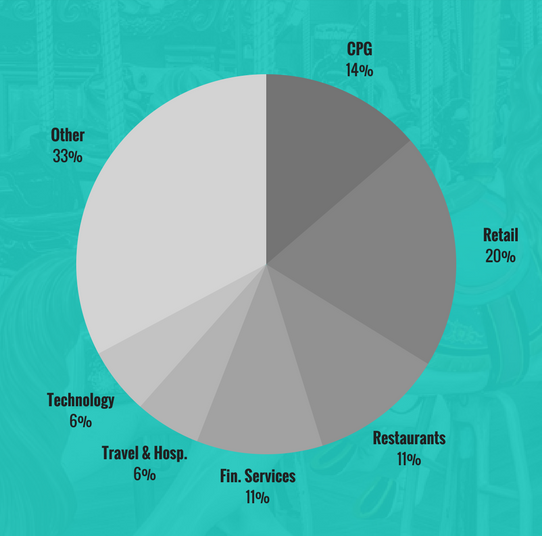
Overall findings
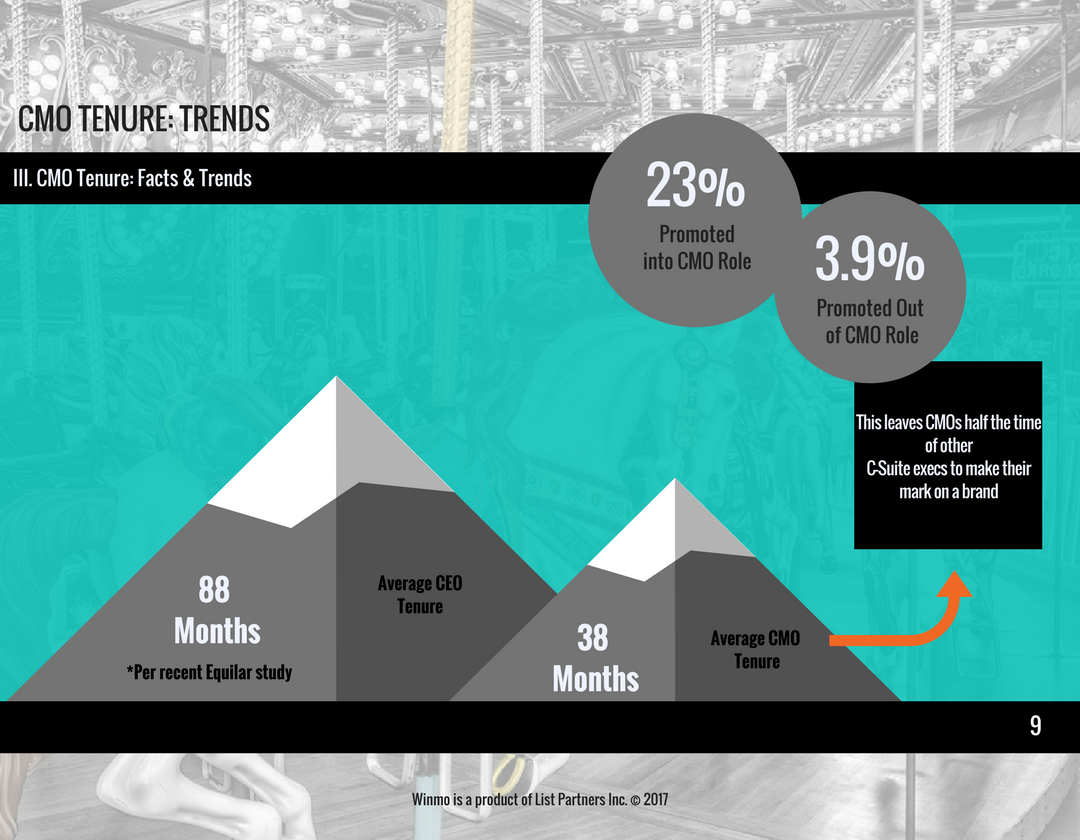
The average CMO tenure is 38 months; median is 27 months.
We found that the average CMO tenure is 38 months (3.2 years), while the median tenure is around 27 months (2.25 years). It is important to know both of these numbers because while the average is the central or typical value of the data set, it is more susceptible to selection bias and is easily skewed. The median, however, is the value at the mid-point of the data set – other values have an equal probability of falling below or above this value. In data sets with outliers, such as 10-year tenures, the median is the best way to describe the data.
Clients should consider the space between these to values as a “sweet spot” of sorts. As we mentioned, CMO shifts are the No. 1 indicator of looming change and being able to predict when these shifts will happen can help whittle down your prospecting lists. Agency readers will want to form relationships with new CMOs and their teams to get in on pitches; media sellers will want to know when new campaign dollars might be available.

CMO’s have half the time to make an impact.
According to a 2016 Equilar study, the average CEO tenure is 88 months. Compare this to our report, which shows CMO tenures around 38 months. This gives CMOs roughly half the time of their CEO to make an impact on the brand.
With such a short runway, CMOs must hit the proverbial ground running as soon as they join a new company. Having the inside track on CMO shifts will allow you to reach out before your competition, ensuring you are top-of-mind when reviews are initiated or new revenue becomes available. Even knowing that a CMO has left a company can be beneficial; engaging with lower ranking team members will likely lead to an introduction once a new CMO is announced.
As digital marketing capabilities advance, CMO tenures will continue to shorten.
The marketing landscape is always changing: CMOs are no longer simply a brand ambassador, setting strategy for traditional buys. The rise of digital advertising has created a demand for CMOs with digital expertise, and those who cannot change with the times usually find themselves crushed under its wheel.
Keep in mind, as well, that ROI on digital advertising is available much faster than with traditional channels, and CEOs/CFOs who do not perceive money as being well spent will ax the one who is responsible. Today’s top markets have much more on their plate than their predecessors and dropping just one ball could spell the end of the ride.
To get full details on our CMO Lifecycle Report and learn the different tenures by industry, download our report here.
Identify Agency Relationships in Business
in Agency New Business, Business Development, Marketing Techby Zoe BlutsteinThere are two groups of people who rule media and marketing budgets: the client decision-makers who own those dollars and the agency teams who decide where they go. For many B2B sales professionals it’s imperative to know both.
If you’re one of them, we’re talking to you. You may have managed to get your hands on that coveted agency org chart. The one that maps out agency staff by account assignment. You know how good it feels. You’ve got the keys to the kingdom! Until a month later when changes make it obsolete, and it’s back to the drawing board (and the gatekeeper).
That’s where we come in. Winmo’s in-house research team doesn’t just track marketing contacts for 40,000+ advertisers and 8,000+ agencies – they map together the relationships between them, so that you can see who works on which account. It’s like having thousands of agency org charts at your fingertips! The keys to thousands of kingdoms! And those who guard their ad budgets, of course.
Here’s how our customers use Winmo to find brand-agency relationships (and conversely agency-brand relationships) in two clicks:
Brand-Agency Relationships
Pretty easy way to do your homework, right? And Winmo makes it just as easy to work opportunities from an agency perspective.
Agency-Brand Relationships
If you’re prospecting an agency, and need decision-makers for specific accounts:
First things first, we’ll tell you everyone at the agency, regardless of what account they work on.
Expand their contact details to see phone numbers, email addresses and more. You can add them to a list you’re building out and export to your CRM, too. As a bonus, you can view client relationships according to things like service provided, ad spend, and tenure.
So why is this function so important to our clients? Like we said before, there are two groups of people who decide where and when a brand will be spending, and our many of our clients need to know both sides of the brand-agency relationship for effective sales outcomes.
See? We’ve been trying to tell you – Winmo helps you engage the right people at the right time. Don’t have it yet? You’re missing out! Start your free trial today.
CMO Breakups: 5 Brands You Should Start Wooing For New Business
in Ad Sales, Agency New Businessby Bryttney BlankenStep aside Cupid! There’s a flurry of CMOs breaking up with brands and we’re here to make it right.
Like any other national holiday centered around love and chocolate-covered deliciousness, no one should be left out in the cold- including big brands. So, we’ve decided to play matchmaker and help mend the broken hearts of five brands that recently went through CMO breakups.
Keep in mind, with any CMO breakup, this typically signals that major agency roster changes are likely to occur in the next 6-18 months. That means that now is the time to start wooing these brands if you want to catch their eye or land some potential new business. They could be your perfect match!
Just a few weeks after Mark Zuckerberg announced that Facebook would limiting the ads on the platform to focus more on family and friends, CMO Gary Briggs decided it was time to see other people. Briggs announced that he would be stepping down from his position, but won’t be leaving until the new CMO comes in and gets situated, however long that may take.
Either way, Briggs will be leaving and a new CMO will be coming in, so changes are coming. That also means advertising, media and other work could be up for grabs, especially given Facebook’s issues since 2016. Start contacting lower level marketing positions (director and VPs), who can help refer you to the new CMO once he/she starts. Your competition for work will include WPP’s Mindshare, which has handled media since 2016. Creative is handled in-house.
Sellers – Facebook attracts a wide range of users to appeal to as many advertisers as possible. Thus, they run traditional and digital ads all year on a variety of platforms. ISpot reports a 2017 national TV spend of $12.1 million. 2016’s spend was $36.6 million.
Request a trial to access the decision maker info for Facebook here
Becky Gebhardt, Lands’ End‘s CMO and chief creative officer decided things weren’t working and left the struggling retailer at the end of 2017. She departed just as Gill Hong and Sarah Rasmusen joined as chief merchandising officer and e-commerce SVP, respectively.
Currently, LE is on a mission to shift spend into “more effective channels,” so look for more direct marketing, in addition to continued digital and print media. Note that LE is planning on opening standalone stores in fiscal 2018 and announced a new partnership with The Weather Channel last November.
Per Pathmatics, LE spent $262,000 on digital display ads in 2017. This is down from the $761,000 spent during 2016. Sellers, while 2016’s spend was targeted to fashion and female-focused sites, 2017 spend shifted into coupon and deal sites. LE does not currently spend on national TV ads, according to iSpot.
Agency and maretch readers – Lands’ End handles traditional marketing in-house, while Dentsu Aegis’s 360i, Atlanta is responsible for digital media buying and planning, search and mobile, according to Winmo. Be sure you are getting pitches together and engaging the team now.
LE has struggled to reach new and existing customers and could be looking for new partners and ideas to reach its target audience through refreshed initiatives.
Request a trial to access the decision maker info for Lands’ End here
Struggling Mattress Firm should be on your prospecting radar after Sicily Dickenson, CMO for only about a year, resigned (I think it went something like “It’s not you, it’s me”). The mattress retailer appears to be bouncing back quickly, already looking for her replacement while marketing VP Christy Sherrick runs the show. Also, six-year CEO Ken Murphy is stepping down. Effective March 1, he will be replaced by Steve Stagner, who has been with Mattress Firm for more than 20 years and is currently executive chairman and chairman of the board.
Major struggles plus changes at the C-suite are a big sign of marketing vendor roster changes to come within the following 18 months, especially when a CMO is involved. Now’s the time for agencies who can handle this account to get on their radar. Stay engaged with those who could be involved in the procurement process and refer you to the new CMO.
Competition down the line will include Spark Foundry (media) and Droga5 (creative), both of which recently won the account. So, agencies and martech readers with omnichannel retail client experience should begin reaching out to get on the company’s radar. Focus on strategies that will help Mattress Firm battle e-commerce upstarts such as Casper, Ghost Bed, Cocoon, Tuft & Needle and myriad others.
Sellers – Mattress Firm’s rising marketing budget includes TV, digital, outdoor, print, radio and social media. Before departing, Dickenson said her yearly marketing budget was $360 million, and spend has been going up since 2015. Spending should (but you never know with these guys) decrease as they shutter underperforming stores, but there’s still a ton of revenue to secure here. (Unless, according to this conspiracy, they have a money laundering operation going on).
National TV buys dominate the retailer’s ad budget. ISpot reports a 2017 national TV spend of $73.3 million, most of which went to female oriented networks and shows (see program targeting right). 2016’s spend was only $26.7 million.
Pathmatics reports a 2017 display spend of $14.8 million, almost double the $12.5 million allocated in 2016. Top ad destinations were youtube.com, my.xfinity.com, crackle.com, mysynchrony.com and answers.com.
Sellers with high engagement rates among female first-time homeowners and renters may have an edge securing revenue. Historically, their top advertising periods are Q3 and Q4.
Request a trial to access the decision maker info for Mattress Firm here
We set our eyes on Lavazza early last year after hiring Brad Armistead as CMO for North America, but recently learned that he left the company late last summer. Maybe Armistead thought it was a summer fling and Lavazza wanted more. Either way, this puts the premium Italian coffee producer on edge. We’re still checking to see if a new decision maker has been appointed, but in the meantime, stay top-of-mind with marketing lieutenants who can refer you to the new CMO once he or she starts.
Agencies and martech readers with beverage experience, especially those with expertise engaging upscale consumers, should have an advantage securing potential work. Competition may include WPP’s MediaCom, which was hired to handle media in 2016.
Sellers – their primary marketing channels include earned/owned media, digital, TV, social media, local marketing around locations and sponsorships (Golden Globes, Wimbledon, art galleries, etc.). Armistead said last year that his marketing budget was $6 million.
Foodie and entertainment sellers will likely have an advantage securing revenue, based on their recent digital ad targeting. Like most coffee brands, the bulk of their ad budget runs during Q3-Q4.
ISpot reports a 2017 national TV spend of $867,359, though the bulk of this came from their Wimbledon sponsorship.
Pathmatics reports that Lavazza’s display spend last year was $939,100, down $1.3 million from 2016. Top ad destinations include youtube.com, foodandwine.com, hollywoodreporter.com, people.com and eonline.com.
Request a trial to access the decision maker info for Lavazza here
Mercy Corps, a Portland, OR-based global humanitarian aid agency, is on the hunt for a new CMO after Dara Royer, who was in the position for just under four years, left in July. She’s chief communications officer at Syracuse University now, and it seems like she’s really happy (Mercy is doing great without her – they’re FINE everything is FINE). In the interim, Mercy veteran Graham Craft, VP of corporate and foundation partnerships since 2014, is leading the department as chief development and marketing officer to lead the department.
Agency and martech readers – since the nonprofit is looking for a new CMO, don’t expect immediate marketing roster changes. However, like we’ve said before, changes could be on the way 6-18 months after hiring a new CMO, so PR and/or digital agencies with nonprofit experience should start getting on Mercy’s radar now. Engage C-suite and lower level marketing personnel, who may be involved in the procurement process, or, at the very least, can refer you to the new decision maker.
Sellers – Mercy’s marketing presence includes a mix of digital, fundraising events, outdoor, print, social, cause marketing and email marketing. They also rely on the help of their partners, including Cisco, Google, Starbucks, TripAdvisor and the BIll & Melinda Gates Foundation.
Further, their ad spend went up considerably in 2017. Pathmatics reports that display alone last year was $890,600, up $640,200 from 2016. Top ad destinations were tripadvisor.com, cnn.com and slickdeals.net. Last year’s budget was placed through Infectious Media (65%), directly (28%) and MediaMath (7%).
Like most nonprofits, Mercy runs most of its ads during Q4-Q1 to cash in on people who are in the giving spirit during the holidays (although, the new tax reform could change this). Otherwise, look for campaigns tied to humanitarian efforts to spur donations. For example, ads now centered around the ongoing Syrian refugee crisis.
Request a trial to access the decision maker info for Mercy Corps here
Getting Better and Better at Doing the Wrong Thing
in Agency New Businessby Tim WilliamsCan you imagine Tesla not tracking how many cars they built last year, or Apple being clueless about the number of iPhones produced in the last 12 months?
Such is the state of affairs in agencies today. Ask agency managers to provide a report enumerating the number and nature of outputs produced and you’re likely to get a blank stare. They can, however, provide an incredibly detailed chronicle of inputs — hours worked. This is the equivalent of Comcast tracking the labor time of its service technicians, but not the number of cable systems they installed.
A borrowed system
In the halcyon days of Don Draper, perhaps this didn’t matter. Agencies were earning an average profit margin of 30%, and workload-per-employee was a fraction of what it is in 2018. Agencies didn’t track or bill for their time because they didn’t need to; they were earning full 15% commissions on large media budgets.
The implementation of the time-based billing model — borrowed from law firms by agency leaders like David Ogilvy in the 1980s — was actually a giant step backward for the industry. The result has been a steady decline in profitability every single decade ever since. Today, average agency profit margins hover just below 10%.
At the same time, client satisfaction with this system is at an all-time low. The bi-annual study conducted by the Association of National Advertisers in the U.S. shows that a clear majority of major global marketers want to change the way they compensate their agencies. While cutting costs is an evergreen concern for marketers, this is not their primary motivation for transforming agency remuneration. Rather, marketers need better business results, and they now realize that renting bodies is not a very effective approach for inspiring optimal performance at their agencies.
The knee-jerk reaction on both sides is to engineer more outcome-based agreements, and for the right kinds of clients and opportunities, this can be a potent way to align economic incentives. But there’s a much more elemental approach every agency can adopt starting tomorrow: stop selling inputs and instead sell outputs.
In other words, stop tracking and selling the efforts required to produce deliverables and instead track and sell the deliverables themselves. This not only conforms to the right paradigm of value (we buy the utility of an item, not the effort required to produce it), it also has the added benefit of forcing much better scope definition and management. Instead of buying ill-defined buckets of inputs, marketers can buy the outputs themselves. This helps agencies predict and manage actual workload, and gives marketers the piece of mind they won’t have to deal with agencies pleading for more money because they’re “out of hours.”
Changing a zero sum game
Making this transformation is a joint venture, requiring a different remuneration dialogue that focuses on what marketers really buy — outputs and outcomes — not hours, hourly rates, or staffing plans. It becomes the agency’s business to manage its internal costs in a way that returns them a fair profit.
The “time machine” that exists inside agencies — the systems that support recording, reporting, analyzing, and attempting to manage “time” — can amount to almost 20% of an agency’s total cost structure. Imagine if that effort were redirected toward measuring what really matters: project velocity, average turnaround time by project type, degree of completion by project phase, percentage of deadlines met, and — most importantly — the effectiveness of the agency’s work and recommendations.
Because agencies and their clients are focused on tracking and managing the wrong thing — inputs instead of outputs and outcomes — they are stuck on a hamster wheel of declining margins for the agency and declining marketing effectiveness for the brand. Marketers cannot hope to secure most talented people — and agencies can’t afford to pay them — if both parties are locked in a zero-sum game centered on the cost of inputs.
It’s high time to move beyond the wringing of hands about the difficulty of changing this system and start by changing the dialogue. As Peter Drucker once advised, there comes a time when we need to “Stop solving the problem and start pursuing the opportunity.”
Here’s How The New Tax Reform Will Affect Nonprofits
in Sponsorshipby Josh ReichThere is a general feeling of worry across the philanthropic landscape. Charities and nonprofits across the country fear a significant decrease in donations as the federal tax reform takes effect.
The reason for concern stems from the doubling of the standard deduction that comes with the new bill. The increase could cause a drop in charitable giving for as many as 30 Million taxpaying Americans.
What is the potential impact of the new bill?
In short – this doesn’t look great for nonprofits. Initial data from the National Tax Policy Center estimates that charitable giving will decline four to six percent in 2018, or between $12 billion and $20 billion. This kind of financial hit could be devastating to smaller nonprofits and could weaken the financial health of larger organizations. According to Tim Delaney, president and CEO of the National Council of Nonprofits,“It’s not that people will stop giving, it’s just that they won’t be incentivized to give as much. And there will be very real consequences from this shortfall.”
So, what are nonprofits doing to prepare?
As a board member of the Lansing Symphony Orchestra, Charley Ballard said, “Any arts organization, whether it’s the theater or ballet, depends on ticket prices to cover a third of your costs. That means the other two thirds will have to come from somewhere else. We kind of look at the tax reform and say, ‘Gosh, our job just got a little bit harder.’”
Others organizations are more optimistic.
“We’re just going to have to work with donors in a new way,” said Rick David, director of California-based social service agency Lighthouse. “It’s a concern, but we’re optimistic at Lighthouse. If our donors gave historically, they’ll continue to give.”
It’s safe to expect organizations like the Lansing Symphony Orchestra and Lighthouse to rethink and revamp their sponsorship efforts. Engaging with the altruism and tugging on the heart strings of donors is nothing new in fundraising, but it will be a common initiative in the coming months.
You may see fundraising and development teams using more sales intelligence tools like Winmo to streamline their prospecting efforts. These organizations don’t typically have large staffs, so anything they can do to make their work more efficient is on the table.
What’s next?
Expect nonprofits to seek funding outside of their “comfort zone.” Corporate sponsorship and partnership deals will remain valuable because unlike many private citizens, corporations will continue to itemize and therefore will still want to take advantage of the deductions (and positive press) that come from philanthropic giving.
It will be interesting to see how it plays out. In all, nonprofits could see major threats and this bill is going to be tough for the nonprofit sector. The underlying theme is that nonprofits will continue to do good in the communities they serve and embrace the new tax reform as any other challenge they have faced in the past – head on.
Get Connected Now! Start Your Winmo Trial.
Facebook Picks Friends Over Publishers
in Ad Sales, Marketing Techby Zoe BlutsteinFacebook is forcing publishers to take a backseat so it can focus on things that really matter – friends and family.
In an announcement made last week, Mark Zuckerberg explained, “Recently we’ve gotten feedback from our community that public content — posts from businesses, brands and media — is crowding out the personal moments [from friends and family] that lead us to connect more with each other.”
In other words, say goodbye to the Facebook News Feed as you know it. Expect to see less sponsored content and suggested posts, and more cheesy engagement photos, baby announcements and blurry images of your Aunt Linda’s cat.
What does this mean for publishers?
Publishers are concerned, and they should be. With the new algorithm prioritizing personal posts over sponsored/suggested content, publishers will likely see a major decrease in Facebook referral traffic.
Those hit the hardest will be publishers that have relied heavily on Facebook to drive traffic. Specifically, smaller, lesser known publishers that have built their following by posting every article to Facebook just to see what sticks. To put it harshly, CEO of Complex Networks Rich Antoniello explains, “Traffic chasers’ fall from grace will be severely expedited. If they were going to be out of business in three years, now it will be 12 months.”
Now, just because it doesn’t look great for the little guys doesn’t mean it’s going to be all puppies and rainbows for the larger publishers. In fact, big publishers who have built a large portion of their following through Facebook, and rely heavily on video, could be in a similar boat as some of these smaller publishers. For example The Market Intelligence Blog reports that Buzzfeed is the biggestrecipient of Facebook referral traffic, meaning this could certainly affect the publisher in a big way.
How did this happen?
To put it simply – I think this was a lack of preparation. Let’s not forget that the transition from print to digital was not exactly the easiest for many publishers. So, as they began to find their footing in the digital space, Facebook was a simple solution for pushing content.
However, as the number of publishers using Facebook grew, the social platform began acting more as a media company – which (we now know) isn’t the direction they planned to go. Now, maybe at the time it didn’t occur to anyone that this would happen, but according to journalist Michael Wolff, “There were always signs that Facebook was unreliable, frequent algorithmic shifts that suddenly disrupted traffic patterns, or, worse, suddenly no traffic at all, and only opaque responses from Facebook executives.” Well, hindsight is always 20/20.
What’s next?
Initially, expect publishers to stumble in the dark for a bit. Like any big change, they will be forced to adjust to a new normal. Once the changes have set in, the primary focus for publishers will be running meaningful content that builds relationships with consumers.
According to Digiday, forward-thinking publishers have been moving focus towards engaging content that drives consumer loyalty and “subscription revenue.” Additionally, aiming to “diversify their traffic sources so they’re less dependent on Facebook, still the second biggest referrer of traffic just after Google.”
Over the next few weeks, publishers will likely watch their Facebook content fade away like distant memories. Once they have gathered themselves and wiped away the tears of what once was, look for their attention to focus on two things: providing content that complies with Facebook’s new algorithm, while also becoming less dependent on the social platform.
Don’t forget: you’re a strong independent publisher who don’t need no Facebook. But you do need Winmo!
Get Connected Now! Start Your Winmo Trial.
How to Close the Deal: Asking the Right Questions to Win More New Business
in Ad Sales, Agency New Businessby Zoe BlutsteinUpdated: August 6, 2019
“Reach out,” they said…” It will be fun,” they said. Reaching out to a prospect can be fun if you are able to turn that outreach into a new business win. However, more than 40% of salespeople say prospecting is the most challenging part of the sales process.
Winning more business being typically comes down to two things: defining the right opportunity and asking the right questions to seamlessly close the deal.
How do you reach out to a prospect?
Sharon Napier, CEO of Partners + Napier, hosted a webinar with us and discussed this in detail. According to Sharon, it all begins with being able to identify the RIGHT opportunity, while also focusing on business you can actually win. Successful new business professionals are able to identify these opportunities by asking really good questions, allowing them to build relationships early on and uncover key insights to help them close the deal later.
According to our research, which you’ll see below, during a four month period 7% of people will exit their current company. So, if you’re already wasting too many hours hunting down qualified prospects, imagine repeating that awful cycle every four months.
Start off by asking engaging questions to understand your prospect’s fit and value. Questions like:
This set of questions get prospects talking about their brand in a new and refreshing way. Not only does this give you a better idea of what they’re looking for, but it allows the prospect to really think about what hasn’t worked for them and why they may need something different.
Asking the Right Budget Questions
When it comes to budget, getting them to share this information is critical because it will allow you to provide realistic expectations from the start. This also allows you to understand why relationships may not have worked in the past – if a brand has a very low budget for an outsourced service, this could explain why the brand isn’t happy with work their current partner/vendor/agency is providing. Uncovering their needs will allow you to provide a tailored solution that is the right fit for your prospect’s need and budget, while highlighting the value you provide.
This leads to the next step, which is ask questions to better understand what your prospect wants. These include questions such as:
Not only does this set up the prospects expectations of you from day one, but it also allows you to understand the needs of your prospect and establish if you are the right fit, and then, if you are, explicitly define your capabilities and your offerings. It might be tempting to cater your services based on all your prospects’ needs, but this is a slippery slope that may result in a client that you can’t satisfy long term. Make sure you clearly define your offerings to avoid this.
Finally, once you have established that this piece of business is right for both you and the prospect, it’s important to establish your odds of actually winning the business. You can do that by asking questions such as:
These questions are not only crucial to understanding where you stand in the process, but it also allows you to address hesitations, clarify any concerns and understand the prospect’s criteria for selecting a product or partner. It’s also important to do research ahead of time. Use specific examples for asking why something you do may come across as a disadvantage to your prospect.
Why Is Asking the Right Questions Important to the Selling Process?
Aside from winning new business, why is asking the right questions important to the selling process? Well, it allows you to invest your time wisely in the right opportunities to increase your closing odds. By increasing your time with the RIGHT opportunities, ultimately decreases your time with the WRONG opportunities, allowing you to focus on the relationships that are worth investing in further. It also allows you to qualify prospects faster, uncover timely opportunities, and invest in building valuable relationships with the opportunities that may need more nurturing to exponentially increase your firm’s odds of closing more new business, faster.
Now that you know the right questions to ask, make sure you’re asking the right person. Find decision maker emails, direct dials and more with Winmo! Start your free trial today!
5 Data Points to Backup Your Winmo Purchase
in Ad Sales, Business Developmentby Jennifer GroeseAre you a data nerd? If you’re like me, I love it when I can backup a decision, or rather ask my boss for investment in a resource when I have all the supporting data points.
While some sales organizations are fortunate enough to have a comprehensive sales stack to help them save time, decrease their sales cycle and win more business, others (perhaps you, if you’re reading this) need a bit more help proving the value of investing in a sales intelligence resource.
Sales intelligence platforms source a HUGE amount of prospecting data, and here’s the best part – they keep it verified for you. Take a second to actually think about that – right now, how long is it taking you to find decision-maker information, and then complimentary details like which agencies they’re working with or how much they spent on digital last quarter? Next, imagine how fast that data is going stale.
According to our research, which you’ll see below, during a four month period 7% of people will exit their current company. So, if you’re already wasting too many hours hunting down qualified prospects, imagine repeating that awful cycle every four months.
Likely you know this pain point very well, but here are some data points to help convince your boss the investment in Winmo is well worth it.
No surprise here but sometimes it’s nice to have a supporting fact that sums up how you’re feeling. You’re not alone!
According to Hubspot, more than 40% of salespeople say prospecting is the most challenging part of the sales process followed by qualifying at 22%. Here’s the thing – if you have the right resources, business development doesn’t have to be hard. Sales intelligence platforms give you the head start you need in order to hone in on the prospects that make the most sense for your business. Customers use Winmo to search across companies, brands, agencies and marketing technology companies using filters like title, industry, planning period, media spend, company revenue and more!
In today’s market there are a lot of shifts happening – people finding new jobs, mergers and acquisitions, as well as brands changing partners on a recurring basis. Amidst all the change, data is becoming outdated…and rapidly. We’ve found that on an annual basis, 30% of contact data will go stale. Even within a four month period 7% of people will exit their current company and an additional 9% will have job title changes.In order to monitor this change and ensure you’re reaching out to the right prospect at the right time it’s crucial to have a resource (or an internal process in place) that’s consistently verifying and updating your database. Perhaps you could rely on bots to do this, but after 22 years managing data we’ve found human verification is the most accurate way to surface reliable information. And besides, who doesn’t want prospecting data that’s dependable, right?
Yes, the 125,000+ decision-makers we include within Winmo are important. But, assuming your boss tells you contact information is easy enough to find, throw this at him/her. Winmo currently maps over 23,000 agency/brand relationships across our database of national advertisers. Whereas you MIGHT be able to dig up contact data on a company’s website or on LinkedIn, take my word for it – you’re not going to find this level of relationship mapping anywhere. And, the time it would take you to navigate this tangled web would be unrealistic.We provide insight into past and current agency relationships, what they manage (creative, multicultural, media buying/planning), which agency location is managing which brand assignment, and then the specific decision-makers within.
Don’t tell my sales team I said this out loud but selling is hard, especially right now! There is more content and technology at sales professionals’ fingertips than ever before, meaning that you’ve got to work even harder to have your prospecting outreach stand out.Imagine if you knew about sales opportunities 3-18 months in advance, and they were delivered directly into your inbox each morning. We’ve got an exceptional team of writers and research analysts on our team (shout out to WinmoEdge) who meticulously monitor and track change throughout the media and advertising industry, and in return translate that data into lead forecasts. They even include when exactly you should start prospecting (for example right now, or 6 months from now).The best part? Knock on wood, but we’re pretty damn good at it. 73% of our lead predictions come true in the timeframe we forecast; and, we just had our 500th successful report in Q4 of 2017.
Since we know data is going stale every single day, of course we put resources behind reviewing and verifying our database. In order to ensure accurate, reliable prospecting data is surfaced for our customers, we have a dedicated in-house research team who are responsible for sourcing the data AND verifying it every 120 days. In fact, on a monthly basis our team is spending over 900 hours each month confirming our data.Why invest in humans; sounds expensive, right? The fact is that the information needed to engage the right people at the right companies is not something that’s conspicuously floating around the web, or accurately crowd-sourced in any other way. Data sourced from anything other than a first-person account still needs to be vetted, verified and confirmed by humans, preferably humans who understand how clients will use this information. While technology has drastically enhanced our processes over the past 22 years, we’ve found found that the most precise information is realized when real human beings are managing it, not bots.
Ready for Winmo? Request a free trial today!